
TimeGuessr
TimeGuessrTrivia
4.947.00 Reviews
- Version
- 4.0.0
- Installs
- 50.00K
- Age Rating
- Everyone
Screenshots
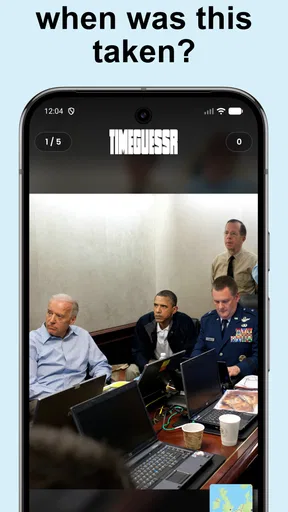
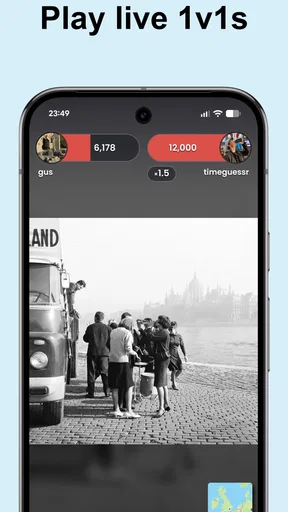
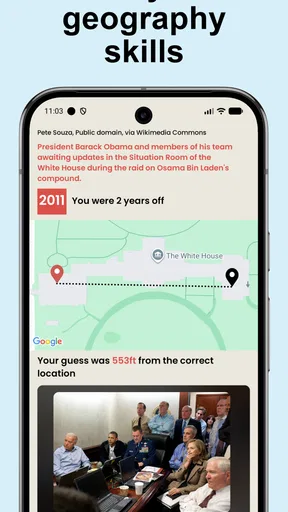
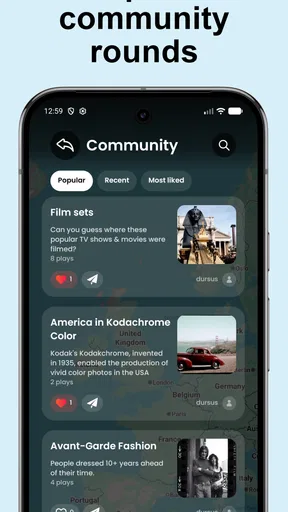
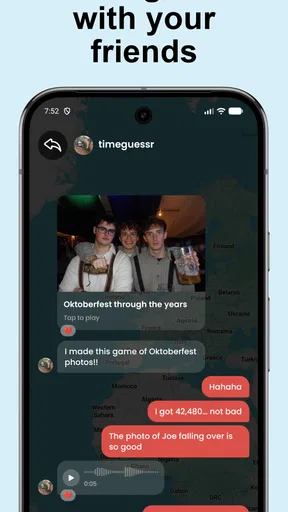
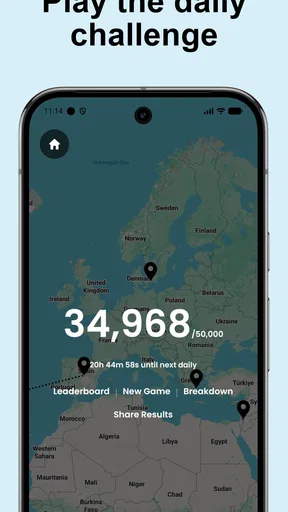
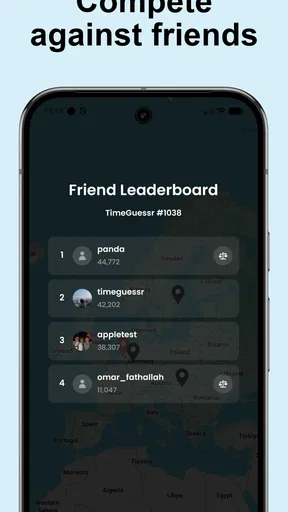
Our Review of TimeGuessr
 Analysis by Appyee
I found TimeGuessr most interesting when I stopped treating it as a quick geography quiz and started using it as a shared conversation game. One person can make a guess, another can challenge the reasoning, and suddenly a photograph becomes a small discussion about places, decades, clothing, architecture, transport, and the way history leaves clues in ordinary scenes. That makes it a particularly good fit for a household with a shared tablet or phone, although it is just as easy to enjoy alone.
This is a free trivia game from TimeGuessr, built around two kinds of knowledge at once: geography and history. Its central appeal is not simply identifying a location. The more useful skill is learning to combine visual evidence with a sense of time. A road, a car, a sign, a building style, or the quality of an image may suggest where a scene belongs, while fashion, technology, and urban design can help narrow down when it was captured. I enjoyed that combination because it rewards curiosity rather than only memorized capitals.
The game is rated for Everyone, carries an average rating of 4.9 from around 3.4 thousand ratings, and has passed 50 thousand installs. Those figures suggest that it has found an audience among people who want something more thoughtful than a conventional multiple-choice quiz. It is free to start, with optional in-app purchases ranging from $4.99 to $24.99 per item, so a household can try the basic experience before deciding whether spending anything makes sense.
How a shared-device session actually works
On a shared device, the simplest approach is to make the game a turn-based activity rather than passing the phone back and forth without a plan. I would give each player a short turn to inspect the image silently, then ask them to name both a place and a time estimate before anyone else offers clues. That small rule makes the discussion much more revealing. Someone may recognize a regional road marking, while another person notices an older vehicle or a change in architectural style.
This format works well after dinner, during a journey, or when a family wants a low-pressure activity that does not require a long explanation. It also suits mixed abilities. A person who knows little geography can still contribute by spotting visual details, while a history enthusiast may be better at estimating the period. The game becomes less about who is already the best and more about how each player reads the same scene.
One of my favorite ways to use it is to ask every player to explain the clue behind a guess. A correct answer reached by luck is less useful than a slightly wrong answer supported by a sensible observation. Over time, this turns each round into a small lesson in visual reasoning. It also prevents the fastest player from dominating simply by calling out a location first.
There is a practical trade-off with shared play: the device holder naturally controls the pace and may see the image for longer. If fairness matters, use a fixed inspection time agreed verbally before each round. I would also avoid looking up clues between turns, because external searching removes the uncertainty that makes the game engaging. The best household sessions feel like collaborative detective work, not a race to consult another app.
Why the geography-and-history combination matters
Many trivia games divide knowledge into neat subjects, but TimeGuessr benefits from the overlap. Geography alone might ask where a landmark is, while history alone might ask when an event happened. Here, the visual setting can require both forms of judgment. A place may look familiar, yet the date changes how the image should be interpreted. A city’s streets, cars, signs, or public spaces can reveal a period as much as a country.
That design creates a useful habit: I learned to separate “Where is this?” from “When does this feel like?” instead of letting my first impression answer both questions. The distinction is important because a recognizable place can still be misleading if the scene belongs to an earlier era. In a group, it gives players two ways to contribute and makes disagreements more productive.
The game is also a good reminder that visual confidence is not the same as accuracy. A polished urban scene may seem easier than a rural one, but familiar-looking cities can share design features. I found it more effective to build a chain of clues: first the broad region, then the likely country, then the period, and only after that a more precise guess. That workflow is one of the strongest reasons to play repeatedly.
Setting expectations on a household device
Before installing it on a shared phone or tablet, I would decide who is allowed to use the device and whether scores are being treated as personal achievements or casual group results. The game is not something I would hand to a child and assume it will automatically manage separate household identities. If several people care about progress, a simple written note or a shared household score sheet is more dependable than relying on assumptions about account boundaries.
This matters because shared-device use can blur ownership. One player may open the game for a quick round, while another later continues from the same place. That is perfectly fine for a family challenge, but it can be frustrating for someone expecting a private record. My advice is to agree on the purpose first: use one device as a communal board, or let each person play independently on their own device where available.
I would also review purchase decisions with the device owner before anyone starts playing. The game itself is free, but optional items cost between $4.99 and $24.99 each. That does not make the game unsuitable for a household, but it does make a clear spending rule sensible. For a child using a parent’s device, the safest arrangement is to make purchases an adult decision rather than something handled casually during play.
The current version is 4.0.0, and the minimum operating-system requirement is Android 7.0. That makes it approachable for many older Android devices, though compatibility is still something I would check on the particular phone or tablet before planning a group session. A household with an aging device should test the game during a quiet moment rather than discovering a technical problem when everyone is ready to play.
Another useful boundary is time. Because a round invites discussion, a “quick game” can become longer than expected, especially when players debate a difficult image. I prefer setting a small number of rounds or a stopping point before beginning. That keeps the game from taking over an evening and makes it easier to include younger players who may lose interest during extended analysis.
Coordinating different players without making it feel like homework
TimeGuessr can become too competitive if the most knowledgeable player explains every answer immediately. I get better results by asking the group to collect clues before revealing conclusions. A player might mention a road layout, another might identify a vehicle style, and a third might estimate the decade. Only then does the group settle on a guess. This keeps participation open even when skill levels are uneven.
For younger players, I would change the goal from exactness to explanation. Ask them what they notice first, whether the scene feels modern or old, and which details support that feeling. They do not need to know a country’s full history to make a useful contribution. The game can build observation skills without turning every round into a test they are expected to pass.
For adults or experienced geography fans, the challenge is avoiding overconfidence. A strong player may recognize a visual pattern quickly, but explaining the reasoning helps everyone learn and exposes weak assumptions. I sometimes make a deliberately cautious first estimate and then revise it after considering another clue. That is a better model for younger players than pretending every answer should arrive instantly.
A simple household rotation also helps: one person reads the image, one person records guesses, and one person keeps time, with those roles changing each round. The game does not need a complicated tournament structure to work well. In fact, too much administration can distract from the images. The useful coordination is just enough to give everyone space and keep the session moving.
There is a second coordination issue for remote households. If players are not in the same room, the experience depends more on each person describing what they see and agreeing on when to reveal guesses. I would not choose it as a substitute for a dedicated online party game if synchronized multiplayer is the main requirement. Its strongest social quality comes from discussing a shared visual prompt, so it is most natural when everyone can focus on the same device or image at the same time.
Age, trust, and the kind of attention it requires
The Everyone rating makes the game easy to consider for a broad household audience, but age suitability is not the only question. A younger player may be welcome in the session while still finding some historical or geographical references unfamiliar. I would present it as a discovery game rather than a knowledge exam. That framing reduces pressure and encourages questions, which are often more valuable than a high score.
Parents and guardians should also think about trust in the ordinary device-use sense. A child may be able to play independently, but an adult should still decide whether the device can be used freely, whether optional purchases are permitted, and whether the child is expected to keep the session within a time limit. Those are household rules, not features I would assume the game provides automatically.
The game is a good match for children who enjoy maps, old photographs, vehicles, cities, or “spot the difference” activities. It may be less suitable for a child who wants rapid action, constant rewards, or a clearly structured story. The same applies to adults who prefer trivia with direct questions and obvious answers. TimeGuessr asks the player to interpret an image, tolerate uncertainty, and sometimes accept that a plausible guess was still wrong.
That uncertainty is also where trust between players matters. In a family setting, someone may be tempted to give away a clue, search for an answer, or claim they recognized a place before the others had time to think. I would agree in advance that hints are either forbidden or earned through a group rule. Without that agreement, the game can feel unfair even when the underlying challenge is enjoyable.
One subtle benefit is that the game can reveal how differently people read the same evidence. A teenager may focus on technology, a parent may notice architecture, and an older relative may recognize a historical atmosphere from personal experience. Those perspectives are not interchangeable, and the game gives them a reason to compare observations. In that sense, its value at home is not limited to the score.
Where it stands beside ordinary trivia alternatives
Compared with a standard quiz app, TimeGuessr gives me more to discuss before answering. Conventional trivia is often efficient: read a question, choose an option, move on. That is better when I want a fast solo session or a broad sweep of facts. This game is slower and more interpretive, but the extra pause creates room for reasoning and conversation.
It also differs from a pure map-guessing game. A map-focused alternative may reward precise location skills, while TimeGuessr adds the historical dimension that changes how a scene should be read. That makes it more appealing to players who enjoy context, but potentially less satisfying for someone who wants a clean test of navigation alone. If your main goal is memorizing borders or capitals, a dedicated geography trainer may be more efficient.
Against a history quiz, the advantage is that the past is presented through visual atmosphere rather than only names and dates. The disadvantage is that visual interpretation can feel subjective. Players who dislike ambiguous clues may prefer an app with clearly defined answers and explanations after every question. I would choose this game for curiosity and discussion, not for a systematic curriculum.
It is also not the best replacement for a party game built around rapid competition. The pleasure here comes from looking carefully and defending a guess. If your group wants noise, speed, and immediate rounds, another trivia format may create more energy. If your group enjoys arguing over whether a street feels like one decade or another, this is the more distinctive choice.
Small strategies that make repeated play better
The first strategy I recommend is to divide clues into reliable and atmospheric ones. Signs, road markings, and recognizable infrastructure may provide stronger geographic evidence, while image quality, clothing, or general mood may be more useful for estimating time. Treating every clue as equally trustworthy leads to confident mistakes. I found that separating them produces guesses that are easier to explain and revise.
The second is to make a two-stage guess. Start with a broad region and time range, then narrow only after discussing the strongest detail. This prevents a familiar landmark or visual stereotype from locking the group into an early answer. It also gives less experienced players a meaningful role because they can help with the broad classification even if they cannot identify the exact place.
The third is to keep a “clue journal” after a session. It does not need to be elaborate. Write down one visual feature that fooled the group and one feature that proved useful. After several sessions, patterns emerge: perhaps the household regularly overestimates how modern a scene is, or perhaps everyone relies too heavily on architecture and ignores vehicles. That reflection turns casual play into genuine improvement.
A fourth useful habit is to let the most knowledgeable player answer last. This protects the group from anchoring on an expert’s first reaction. It also gives everyone else time to form an independent view. In my experience, the discussion becomes more interesting when the strongest player has to evaluate several competing explanations rather than simply announce the solution.
Finally, decide whether the household values accuracy or reasoning before keeping scores. If accuracy is the only measure, beginners may stop contributing. If the group awards informal credit for a well-supported clue, the game stays welcoming while still rewarding knowledge. That approach fits the design better than pretending every round measures expertise perfectly.
My household verdict after living with the idea
I recommend TimeGuessr for households that want a thoughtful shared activity built around images, places, and historical clues. Its strongest quality is the way it creates a reason to talk. A single scene can bring out different kinds of knowledge, and the game remains interesting even when nobody is certain. The free entry point makes it easy to test with a family or group of friends before deciding whether optional purchases are worthwhile.
I would be more cautious about recommending it to someone seeking private progress boundaries on a shared device, a highly structured learning course, or a fast party-game rhythm. The household needs to provide its own rules for turns, spending, time, and score ownership. That is not a serious flaw, but it is important to understand before installing it for several people.
For a parent, the best use is a short, cooperative session where children are encouraged to explain what they see rather than compete with adults on stored knowledge. For adults, it works as a relaxed geography-and-history challenge that rewards careful observation. For a solo player, it offers a more reflective alternative to rapid-fire trivia, provided uncertainty is part of the appeal rather than a source of irritation.
TimeGuessr is developed by TimeGuessr and belongs to the trivia category, but I think those labels undersell its character. I experienced it less as a database of questions and more as a visual reasoning exercise that happens to produce scores. If your household enjoys debating clues, learning from mistakes, and sharing one screen without needing constant action, this is a game I would gladly keep installed.
Verdict
Strengths of TimeGuessr
- Fun way to learn world geography through real-life photos.
- Rounds are quick, making it easy to play during short breaks.
- Scoring rewards both location accuracy and date estimation.
- Daily challenges encourage regular play and friendly competition.
- Simple controls make the game accessible to beginners.
Limitations of TimeGuessr
- Some images provide too few clues for a confident guess.
- Accurate year estimates can feel difficult without historical knowledge.
- Competitive features may be less appealing to casual players.
- Internet access is generally needed for the full experience.
- Repeated locations or familiar images can reduce replay variety.
Similar Picks in This Category
View All
Millionaire 2026 Quiz & Trivia
Quiz & Trivia Games by Submarine Apps4.5

Brain Test 2: Tricky Stories
Unico Studio4.7

Trivia Crack: Brain Quiz Games
etermax4.4

QuizzLand. Quiz & Trivia game
Quiz & Trivia Games by Mno Go Apps4.8

Brain Test: Tricky Puzzles
Unico Studio4.7

Logo Quiz
bubble quiz games4.5
Frequently Asked Questions
What is TimeGuessr and how does the game work?
TimeGuessr is a history and geography quiz game that challenges you to identify when and where a photograph was taken. Each round presents an image connected to a particular place and period, and you make your best guesses using visual clues such as clothing, vehicles, architecture, technology, landscapes, and historical events. Your score generally improves when your location and estimated year are close to the correct answers.
Can beginners play TimeGuessr without extensive historical knowledge?
Yes. TimeGuessr is accessible to beginners, even if you cannot immediately recognize historical events or locations. Many questions can be solved by observing practical details in the image, including road signs, building styles, cars, fashion, flags, and image quality. However, players with stronger geography and history knowledge may have an advantage. The game is also useful for learning because each round encourages you to examine details and remember visual patterns.
Is TimeGuessr free to play, and are there any in-app purchases?
TimeGuessr may offer free access to its core quiz experience, but availability, features, advertisements, and optional paid content can vary depending on the platform and version you use. Before downloading or signing up, check the official store listing or the game’s website for current pricing information. Also review whether premium features, extra game modes, subscriptions, or ad removal are included in your region.
Does TimeGuessr require an internet connection?
TimeGuessr is primarily designed as an online experience, so an internet connection may be needed to load photographs, submit guesses, retrieve answers, and compare scores. Offline play should not be assumed unless the current version specifically advertises it. A stable connection is recommended, particularly during timed rounds or competitive sessions, because interruptions could affect loading, answer submission, or your ability to participate in daily and multiplayer challenges.
Is TimeGuessr suitable for children and does it collect personal data?
TimeGuessr can be entertaining and educational for older children, teenagers, and adults, but suitability depends on the images and historical subjects included in the version you access. Some photographs may depict serious events, conflict, disasters, or mature historical themes. Parents should review the game’s age rating, privacy policy, account requirements, advertising practices, and data permissions before allowing a child to play, especially if social or leaderboard features are enabled.
Play our best games!


